Use-cases

The power of bAWARE lies in a simple but revolutionary idea: real-time information and response — available directly on board the wild animal. With this principle, the potential applications are virtually endless.

The core concept is patent-pending, as are several specific implementations designed for different conservation challenges.

Bird electrocution on power lines

Power lines electrocute a bird roughly every three seconds. bAWARE's wearable sensor detects a live line and warns the bird away before it touches the wire.

In detail, with sources: how many birds die, the methods compared, grid operators prosecuted or ordered to act, three electrocuted Philippine eagles.

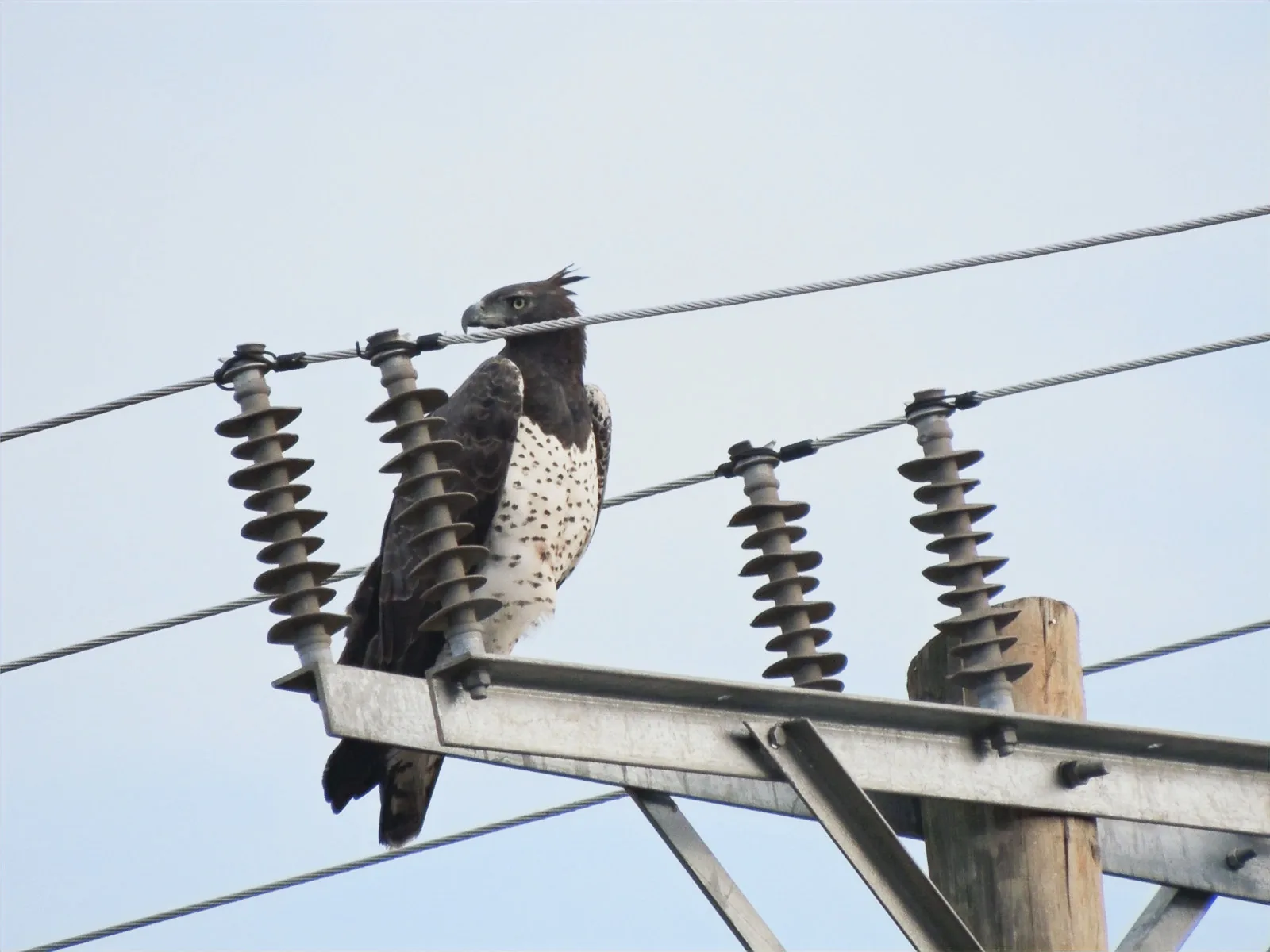
Martial eagle perched on a power-pole crossarm between insulators in Laikipia, Kenya
This line in Laikipia/Kenya wasn't powered yet when the picture was taken. Otherwise, connecting 2 wires, or 1 wire to the earthed cross bar would be fatal for this martial eagle.

Collisions with power lines

Here, the very high voltage lines of ~60 to many hundred kV are concerned. Their phases are far enough apart, their insulators tall enough, but often they carry more than 3 phases, and sometimes several lines run in parallel. The cables of these powerlines are often invisible to large, fast flying birds, especially those flying at dusk or dawn, against the sun, and flying in flocks. The birds that collide most are great bustards, the kori bustard and the great Indian bustard, the last of which stands to become extinct due to power distribution infrastructure; cranes as a group; and cormorants. Vultures, lammergeyers and large eagles collide too, mostly with the thin earth or lightning wire on top, sometimes a fibre-optic one. They might dodge the first cable, but crash into the next, breaking wings.

bAWARE being able to detect even the weakest of bare cable powerlines, it can detect those large lines at even greater warning distances. Only time will tell, but we expect that even a small number of equipped birds in a flock turning away, will induce the entire flock to avoid the obstacle.

In detail, with sources: line markers and flight diverters, the ruling of India’s Supreme Court for the great Indian bustard.

Collisions with wind turbines

The locations of wind turbines and entire parks are well known and documented. On the other hand, their electrical fields are weak, and the needed warning distance is great, given that modern turbines are amongst the tallest human-made structures, and the blade tips move as fast as a Formula 1 car at full speed — around 300 km/h, and faster offshore.

bAWARE therefore combines the localisation ability of classic tags with a database of large 3D hazards such as wind turbines, but also airports, and then uses geo-fencing and the built-in alarms to deter the birds from approaching dangerously close.

Cases, with sources: running wind farms stopped, fined or put under conditions; projects refused, reduced or delayed over protected birds.

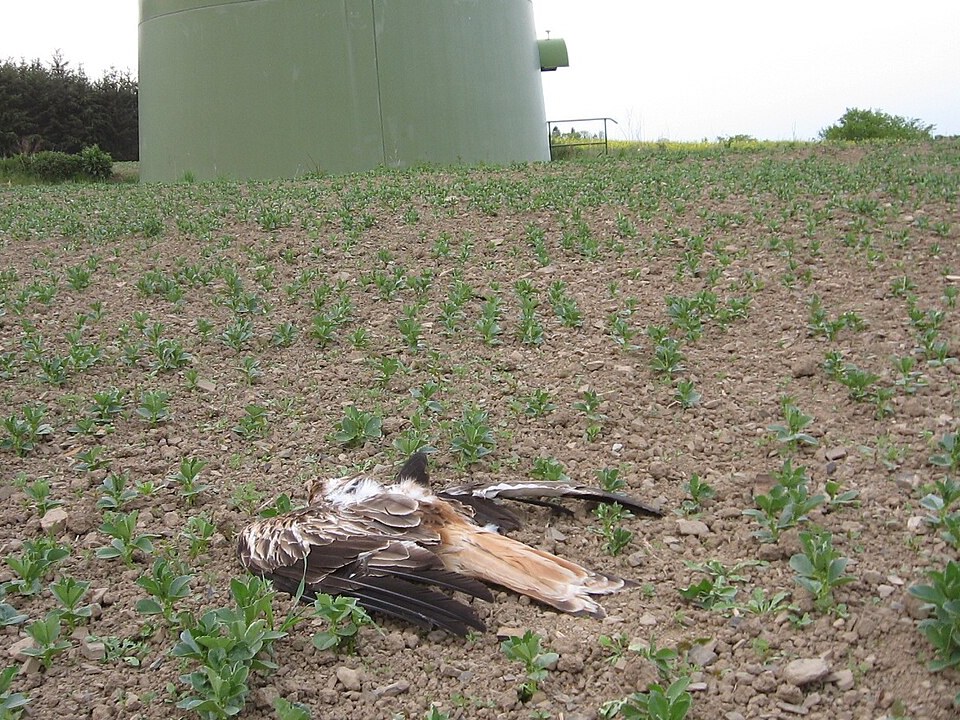
Dead red kite in a field, 25 metres from a wind turbine
Red kite killed by a wind turbine, lying only 25 m from it, Arnsberg-Kirchlinde, Germany, 18 May 2016. Westphalia’s chemical and veterinary investigations authority confirmed that it died of blunt force trauma. Photo: Martin Lindner, CC BY-SA 3.0, cropped.
Photo: Martin Lindner, CC BY-SA 3.0

The principle of real-time information and response — available directly on board the wild animal — could also help large carnivores such as lions, wolves and bears, and many other species.