

When protected birds stand between your project and its permit
Quick access · Developers, lenders and consultancies (planning stage, IFC PS 6) · Last updated October 2026
For: wind and grid developers, development banks and commercial lenders, and the environmental consultancies who prepare environmental and social impact assessments (ESIA), biodiversity action plans and offset strategies.
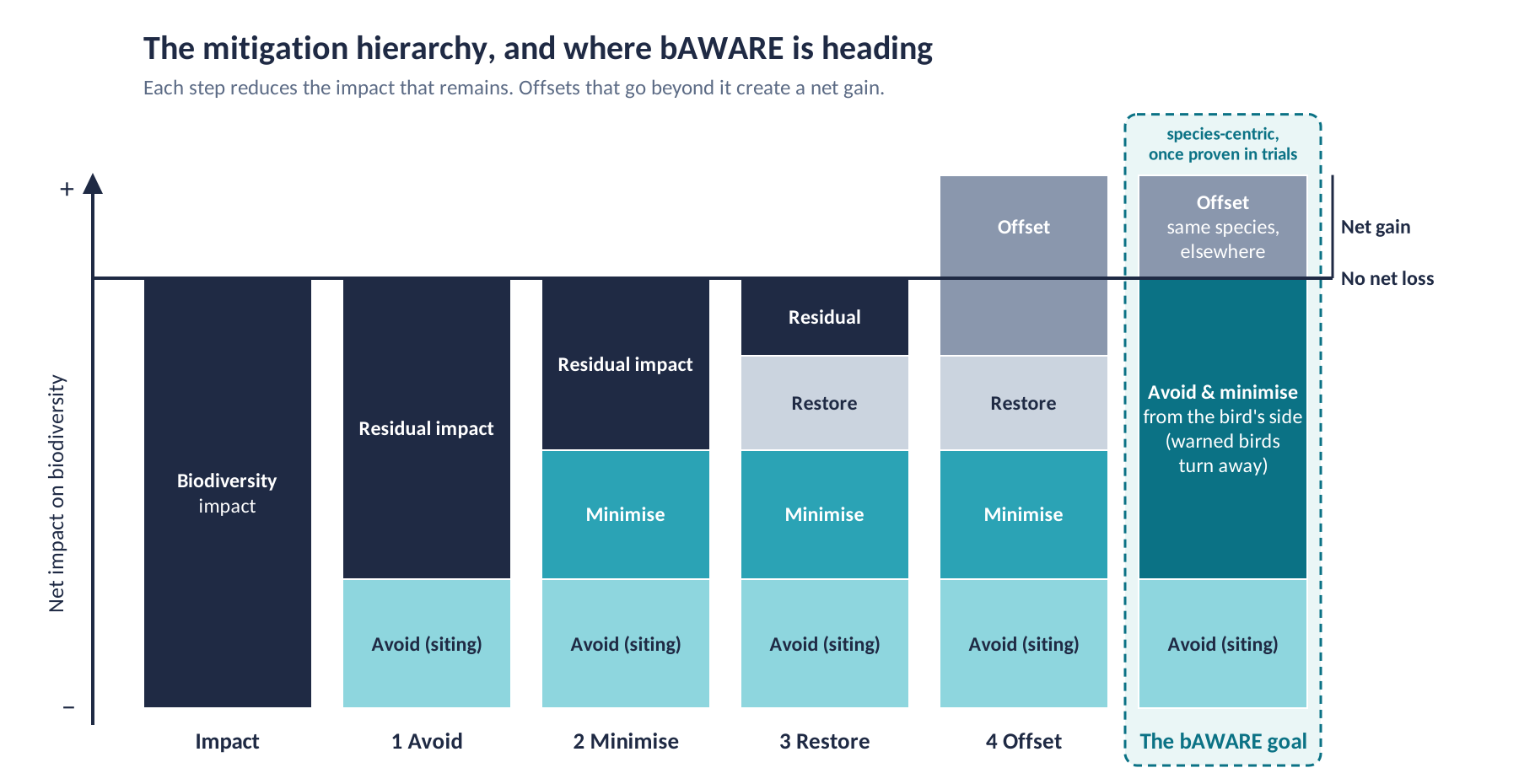
In short: A planned wind farm or power line in the range of a rare eagle, kite or vulture can be refused, cut down in size, delayed for years, or consented only with exclusion zones and curtailment conditions. Lenders and regulators expect the developer to work through the mitigation hierarchy: avoid, minimise, restore, and offset only what remains. bAWARE is a tag worn by the bird that warns it before it reaches a turbine or a live power line, so that the bird turns away, and it records where and when each danger was avoided. Once rigorous field trials have proven its effectiveness, it is meant to qualify as a measure in three tiers of the hierarchy: avoidance from the bird's side, minimisation without stopping the turbines, and offsets for the same species elsewhere. That proof comes first. This page explains the problem, where bAWARE is heading, and what is possible today.
Why bird risk bites hardest before construction
Permitting is asymmetric. Once a line or a wind farm is running, hundreds of thousands of people depend on its power, and a court or regulator weighs shutting it down very differently. A project that exists only on paper has no such constituency. Local opposition is often organised before the first survey; usually only the utility knows why the extra capacity is needed; and no group of consumers lobbies for one more line or one more wind farm. A protected raptor therefore weighs most heavily at the planning stage: in refusals, in turbines cut from the layout, in years of delay, and in permit conditions that last for the life of the asset.
The cases below are all decisions taken before or instead of construction.
Cases: projects refused, reduced or delayed over protected birds
| Project | Country, year | Species | What happened |
|---|---|---|---|
| Inyanda-Roodeplaat (Eastern Cape) | South Africa, 2018–2021 | Verreaux's eagle, martial eagle, black harrier | Environmental authorisation for 47 turbines (187.2 MW) was granted in April 2018. BirdLife South Africa and four other parties appealed, and the minister sent the decision back in 2019 [1]. A review found that the bird study had understated collision risk and that the proposed mitigation was "untested and inappropriate"; on 18 February 2021 the authorisation was refused [2]. |
| Cebadera, Cordel and Fuenteungrillo (Antequera, Málaga) | Spain, 2025 | Bonelli's eagle, Egyptian vulture, golden eagle, lesser kestrel | The regional government issued binding negative environmental reports for three planned wind farms with 19 turbines and 117.8 MW in total, citing very significant effects on endangered birds, including several Bonelli's eagle territories [3]. |
| Galloo Island Wind (Lake Ontario, New York) | USA, 2019 | Bald eagle | The developer had left a bald-eagle nest sighting out of its application. With its agreement, the state review was extended beyond its one-year limit, pushing the earliest construction start back a year. In February 2019 the developer withdrew its applications for the 108 MW project; the eagle was not the stated reason [4]. |
| Els Pesells (Horta de Sant Joan, Tarragona) | Spain, 2012 | Eagles (vulnerable species) | The High Court of Catalonia annulled the relocation of turbines authorised in 2007, because no environmental impact assessment had been made for the change and because of its possible effect on the eagles [5]. |
| Great Indian bustard range (Rajasthan, Gujarat) | India, 2025 | Great Indian bustard | The Supreme Court ruled that no new wind or solar parks over 2 MW may be built in the bustard's priority areas and that 33 kV lines there must be put underground or rerouted [6]. |
| Viking Wind Farm (Shetland) | United Kingdom, 2009–2015 | Whimbrel | Applied for with 150 turbines in 2009 and reduced to 127 in 2010; consent was granted for 103 turbines in April 2012. Opponents argued, among other things, that consent breached the Birds Directive for the whimbrel. The challenge succeeded in the Court of Session in 2013 and was finally dismissed by the UK Supreme Court on 9 February 2015, six years after the application [7]. |
The pattern: at the planning stage a protected bird, most often a raptor, costs turbines, years and conditions, and sometimes the whole site. The weaker the bird study and the mitigation, the higher the price.
What the planning stage costs in time and money
Across the EU, an environmental impact assessment costs on average about 1 % of total project cost, and the procedure takes 11.6 months on average, ranging from 5 to 27 months between member states [8].
In Germany, onshore wind projects took on average a little over four years from project start to permit, and about five years to commissioning. Planning and permitting up to the permit cost on average about €70 per kW, roughly €7 million for a 100 MW wind farm. Species-protection surveys alone take at least 12 months and averaged 18 [9].
Lenders and agencies ask for at least a continuous 12-month bird survey before construction [10]; Scotland's nature agency recommends at least two years [11].
All of that is spent before anyone knows whether the birds will allow the project.
What lenders and regulators require
Lenders: the IFC Performance Standards and the banks that apply them
IFC Performance Standard 6 (PS6) requires the mitigation hierarchy: avoid impacts, minimise them where they cannot be avoided, restore, and offset only residual impacts [12]. In natural habitat the aim is no net loss (paragraph 15). Critical habitat includes areas important for critically endangered or endangered species and for concentrations of migratory or congregatory species (paragraph 16). There, a project may proceed only if it causes no measurable adverse impact on those species, no net reduction in their population, and is backed by long-term monitoring (paragraph 17), with a Biodiversity Action Plan designed for net gains (paragraph 18) [12].
The Equator Principles (EP4) apply to project finance with total capital costs of US$10 million or more. In countries without robust host-country standards, compliance with the IFC Performance Standards is required; an independent environmental and social consultant reviews the assessment; and the borrower covenants to comply with the management plans, with the bank reserving remedies up to an event of default [13].
EBRD: the client must, as a priority, avoid adverse impacts on biodiversity and consider offsets only as a last resort. In critical habitat the project must be designed to deliver net gains, and not every residual impact can be offset; where it cannot, the project has to be redesigned [14].
EIB: the mitigation hierarchy applies, compensation is "a last resort solution", collision risk is named among the threats to assess, and the promoter is expected to manage adaptively in response to monitoring [15].
African Development Bank: the assessment must always apply the mitigation hierarchy, starting with avoidance; the bank states that it "has reservations regarding the long-term success of biodiversity offsets" and takes a precautionary approach to them [16].
Power-line guidelines: the World Bank Group's guidelines for electric power transmission and distribution ask for line corridors that avoid critical habitats such as nesting areas, colonies and migration routes; 1.5 m between energised parts and earthed hardware, or covers where that is not feasible; retrofits of existing lines; and underground lines in sensitive areas [17].
Power lines, 2026: an IFC and EBRD tip sheet of February 2026 calls electrocution on distribution lines "a major threat to many bird species" and states that certain storks, vultures, eagles and eagle owls face extinction as a result. It applies the mitigation hierarchy to new lines: bury them where feasible; otherwise keep live parts at safe distances set by the wingspan of the largest birds at risk (a baseline of 150 cm horizontally and 100 cm vertically), prefer suspended to upright pin insulators, insulate, and retrofit existing lines by priority of risk [18].
Wind-specific guidance: the World Bank Group's wind guidelines ask for siting away from sensitive areas, site-, species- and season-specific surveys before construction, curtailment or shutdown on demand near high-value areas, and carcass monitoring for at least one to three years after commissioning. The same paragraph that describes curtailment also asks for emerging deterrent technologies to be assessed [19].
Lenders finance bird conditions as part of the deal. The EBRD's loan to the 500 MW Ras Ghareb wind farm in the Gulf of Suez came with an active turbine management plan and a shutdown programme for migrating birds [20]. At Kipeto in Kenya, turbines stop about 1,000 times a year for vultures [21], and a separate US$10 million loan, arranged by The Nature Conservancy, pays for the wind farm's Biodiversity Action Plan and its commitment to a net gain of critically endangered vultures [22].
And the risk does not end at financial close. At the 500 MW Zarafshon wind farm in Uzbekistan, financed by IFC, a complaint filed in March 2024 raised concerns for vultures, golden eagles and saker falcons, inadequate nest buffers and the lack of independent bird monitoring; it went to mediation under the IFC's ombudsman [23]. At the Shokpar wind farm in Kazakhstan, financed by the EBRD with the Asian Infrastructure Investment Bank and the Green Climate Fund, a 2024 complaint about threatened birds ended without agreement in 2026 and moved on to compliance assessment [24]. Our page for utilities in operation is full of such cases, whether or not protected birds were considered when the projects were first financed.
Regulators: exclusion zones, survey years and compensation
Germany: the Federal Nature Conservation Act lists 15 collision-sensitive breeding birds and sets check zones around their nests, for example 500 m, 1,200 m and 3,500 m for the red kite and 500 m, 2,000 m and 5,000 m for the white-tailed eagle [25]. Curtailment is considered unreasonable once it costs more than 6 % of annual yield, or 8 % at the best sites [26]. Anti-collision systems are so far recognised as a protective measure only for the red kite [25][27].
United States: a wind farm qualifies for a general eagle permit only if its turbines stand at least 2 miles from golden-eagle nests and 660 feet from bald-eagle nests, in areas below set eagle-abundance thresholds. It must buy compensatory mitigation credits from an approved conservation bank or in-lieu fee programme; the approved offsets are power-pole retrofits and lead abatement [28][29].
Power lines: conventions and national law
Convention on Migratory Species: parties are urged to start bird baseline studies as early as possible in the planning of any power line, to avoid major migration flyways and Important Bird Areas, to put licensing and permitting procedures in place that integrate migratory birds, and to modify the most dangerous existing line sections "as a matter of priority" [30]. Technical guidelines for Africa and Eurasia go with it [31].
Bern Convention: new poles should be built so that birds cannot be electrocuted, and dangerous medium-voltage poles in places important for birds should be made safe [32].
Germany: new medium-voltage poles must be built so that birds are protected against electrocution, and existing high-risk poles had to be made safe by the end of 2012 [33].
Spain: in designated protection zones, lines of 1 kV and above with bare conductors must meet anti-electrocution rules, existing lines included [34]. From 2027 to 2030, new grid investment plans may include adapting existing lines to the national bird-protection rules [35].
United States: eagles are protected by federal law [36]. Since 2024, power-line operators can hold a general eagle permit that obliges them to retrofit within a year of every eagle electrocution they find, and to convert a share of their existing poles to avian-safe designs in every permit period [29].
Every check zone is land that cannot be developed, every survey year is a year before consent, and every curtailment condition is lost generation for the life of the project.
The standard toolbox at the planning stage, and where it runs out
Siting and exclusion zones are the strongest tool and come first. Their price is land: the 3,500 m extended check zone around a single red-kite nest covers about 38 km² [25].
Curtailment conditions written into the permit work: in southern Spain, stopping individual turbines when griffon vultures approached cut vulture deaths by 92.8 % for 0.51 % of annual generation, but it took about 6,700 stops a year and observers on site every day [37]. In a permit they are a cost for the life of the asset.
Detection systems at the turbine have a limited reach and contested evidence. A camera-based system cut eagle deaths by 82 % in one study [38]; a reanalysis of the same data found far weaker evidence [39], which the original authors dispute [40].
Deterrents have not delivered so far: the EBRD's 2026 briefing note states that no bird deterrent has proved consistently effective [10].
Bird-safe design of power lines works where it is built in: burial, safe distances and insulation, as set out in the IFC and EBRD tip sheet. Every measure in it is on the pole [18].
Offsets come last and are not always possible: lenders accept them only for residual impacts, and in critical habitat some impacts cannot be offset at all [14][12].
All of these act from the infrastructure's side. Each one protects the bird by moving the project, shrinking it or stopping it.
Co-existence, not either-or: where bAWARE is heading
The choice offered today is too often one or the other: green energy, or any new energy infrastructure at all, against rare birds. Technology is at the root of the conflict: turbines and power lines kill the birds. Technology should also let both exist at the same time. That is the co-existence bAWARE is built to enable.
In a perfect world, animals would know where the danger is and avoid it completely. If every bird at risk had a sixth sense for collisions and electrocutions, lent by technology such as bAWARE, avoidance could cover all of them. Our aim is to do better than minimising or even offsetting the damage: to prevent it. Along the way, bAWARE can serve every tier of the hierarchy that lenders and regulators work with.
What bAWARE is not: a way to skip a step. A supplier who seems to offer a shortcut past siting or bird-safe design is a compliance liability, not a help, and bAWARE never replaces insulating or redesigning dangerous poles. Its place is the gap those measures leave: individual birds of a rare species that range far beyond the poles a project can fix, or cross borders that no single operator controls.
bAWARE works from the other side: on the bird. The tag senses the electric field of live power lines and warns the bird, first with a sound and then, if it keeps coming, with a harmless electro-tactile stimulus that discourages the approach. At wind turbines, whose electric fields are far too weak to sense at a safe distance, it uses geofencing: the tag knows its own position and carries a stored map of turbine positions as no-fly zones. The bird turns away; the turbine keeps turning.
Once its effectiveness has been proven in rigorous field trials, bAWARE is designed to qualify as a measure in three tiers of the hierarchy:
Avoid: from the bird's side
Siting comes first, and bAWARE does not change where a project should go. What it adds is avoidance on the bird's side: the tagged bird avoids the turbine or the line, so the impact is prevented before it happens rather than reduced afterwards. Where a site is constrained by the territories of a few breeding pairs of one critical species, warning those birds keeps them away from the hazard instead of keeping the project away from the birds.
Minimise: operational mortality without stopping the turbines
At the minimisation tier, bAWARE addresses the deaths the permit conditions are written for, without curtailment: no lost production, no daytime stops, no wear from frequent halts. It works wherever the bird flies, including on migration across many wind farms and power lines. The two approaches have opposite blind spots: measures on the turbine or pole protect every bird at that structure; bAWARE protects the individual birds that wear it, wherever they go.
Offset: protecting the same species elsewhere
Offsets for raptors already take this form: "averted loss" offsets, which prevent damage that would otherwise happen elsewhere [41]. In the United States, the approved offsets for eagles killed at wind farms are power-pole retrofits and lead abatement: they remove other causes of death for the same species [28]. Roughly one bird is electrocuted every three seconds worldwide, about 10 million a year [42]. A project could fund tags for the same species on the distribution lines of its wider range, and each tag would record where and when a danger was avoided. Combined with GPS, the tagged birds also mark the poles they actually use: a retrofit priority list for the offset programme, drawn by the birds themselves.
This is species-centric rather than infrastructure-centric thinking. Seen from the bird, it does not matter whether a danger is avoided at the project's own turbines or on a power line a hundred kilometres away. For the same population, bAWARE can minimise the risk at the project and offset it elsewhere in the species' range, so that the species ends up with a net gain. Some species need exactly that.
Data for monitoring and nature-related reporting
Lenders and regulators ask for monitoring and adaptive management [12][15]. Combined with its localisation (e.g. GPS) and data transmission (e.g. LTE), bAWARE records where and when a protected bird approached a live line or a turbine, how it reacted and how it avoided the danger. The bird's positions and reactions go to the bAWARE backend and on to the scientists who study the species; they can be shared with the project. That is evidence of birds that lived, not only a count of birds found dead.
The same data matter beyond the permit. 733 organisations with over US$22 trillion of assets under management have committed to report on nature along the lines of the Taskforce on Nature-related Financial Disclosures (TNFD) [43], and the International Sustainability Standards Board (ISSB) planned to publish its proposed nature-related disclosure requirements for consultation in October 2026 [44]. The TNFD's guidance for electric utilities and power generators names bird collisions with turbine blades and electrocution on power lines among the impacts to consider, and shutdown procedures and bird flight diverters among the responses [45]. A classic tracking tag measures where birds fly and where they die. A tag that also warns the bird can change that outcome, and records the change: data on the response, not only on the impact.
Where it fits best: a project in the range of a rare raptor of about 800 g and above, whether a few resident breeding pairs or birds migrating through. Where it does not: species nobody will tag.
The two approaches have opposite blind spots. That is exactly why both are needed.
Environmental consultancies: the bridge to proof and approval
Between a new measure and its acceptance stand the environmental consultancies. They survey the birds, write the impact assessment, design the biodiversity action plan, the monitoring and the offsets, and, as independent reviewers, tell lenders whether all of it holds up [13]. What they recommend becomes what regulators and banks expect. For bAWARE, they are the gatekeepers to the end game, and the best partners on the way there.
We want field trials that stand up to exactly that scrutiny. Consultancies and the ornithologists who work with them can help design them: which species and sites, what counts as a danger avoided, and how avoided dangers translate into birds that survive. Evidence built to their standards from the start is evidence they can later put in front of a regulator or a lender.
The road from here
Sensor, electro-tactile stimulus and release now work in prototype, repeatedly, on real power lines and on live birds. The sensor has been tested many times on real lines in the Pyrenees since March 2026, on 20 kV wooden poles and 63 kV lattice towers. Geofencing is a tried and tested technology; it will work because bAWARE's actuators are working. Pre-series tags will be available in 2027.
What is still missing is the proof that counts in an approval process: the integrated system needs rigorous, scientific field trials and quantified, published evidence of its effectiveness. That is our next step, and it is why we are looking for scientific and field partners. The results belong in the record either way. Only once effectiveness has been proven is the road open for bAWARE to qualify as a measure in the mitigation hierarchy. Until then, an environmental impact assessment cannot rely on it, and we do not ask anyone to. Regulators reject mitigation they consider untested [2], and lenders and agencies are right to: deterrents that looked promising have so far not proved consistently effective [10].
Until that proof is in, bAWARE is for those who choose to act on early evidence: developers, lenders and conservation partners who want to go beyond compliance, for example in a biodiversity action plan aiming at net gain, and who are willing to host or support a field trial with the species concerned. For projects entering planning now, the timing works: baseline surveys alone take one to two years [10][11], and from start to permit a German wind farm took on average more than four years [9].
Talk to us
If you are developing or financing a project in the range of a protected raptor, or you assess such projects as a consultancy, and you want to help produce the proof, tell us through the contact page. We are not seeking funding. What we look for in field partners is described under “Who we are looking for”.
Related: Utilities in operation · Who we are looking for · The methods compared · FAQ
Frequently asked questions
Can an environmental impact assessment rely on bAWARE today?
No. Until rigorous field trials have proven its effectiveness, bAWARE is not a measure an assessment, a regulator or a lender can rely on, and we do not present it as one. Today it is for partners who want to help produce that proof.
Where will bAWARE sit in the mitigation hierarchy once proven?
In three tiers. Avoidance from the bird's side: the tagged bird avoids the turbine or line, while siting stays the developer's first step. Minimisation: fewer deaths of the critical species in operation, without curtailment. Offsets: protecting the same species from electrocution elsewhere in its range. It is not a restoration measure.
Could bAWARE one day replace exclusion zones or curtailment conditions?
It depends. Exclusion zones and curtailment protect every bird near a given turbine or pole; bAWARE protects the individual birds that wear it, wherever they fly. Where the whole issue is a handful of breeding raptors, warning those birds could become a fully viable alternative once its effectiveness is proven. In general, the two approaches have opposite blind spots, which is why both are needed.
Could tagging count as an offset?
It follows the same logic as approved raptor offsets: removing another cause of death for the same species, as US eagle permits do with power-pole retrofits [28]. Whether a regulator or lender accepts it will depend on the proof of effectiveness and, for each project, on their decision; the tag's records of dangers avoided would provide the measurable evidence that offset programmes need.
What can a developer or lender do today?
Host or support a controlled field trial with the species that matters for your project, as part of a beyond-compliance commitment such as a net-gain biodiversity plan. You help produce the evidence, and you see it first.
Which species is bAWARE for?
Rare and protected birds of prey, or similar large birds, of about 800 g and above: eagles, kites, buzzards, vultures and large falcons, including migrating birds. Not species nobody will tag.
Sources
- BirdLife International (2019). Great news: BirdLife South Africa halts plans for dangerous wind farm. 20 May 2019. https://www.birdlife.org/news/2019/05/20/great-news-birdlife-south-africa-halts-plans-for-dangerous-wind-farm/
- GroundUp (2021). Watsons’ controversial wind farm approval overturned on review [Inyanda-Roodeplaat Wind Energy Facility, Eastern Cape; environmental authorisation refused 18 February 2021]. 24 March 2021. https://groundup.news/article/watsons-controversial-wind-farm-approval-overturned-on-review/
- Infobae (2025). La Junta de Andalucía veta tres parques eólicos en Málaga por causar afecciones muy significativas a aves en peligro de extinción. 23 July 2025. https://www.infobae.com/espana/2025/07/23/la-junta-de-andalucia-veta-tres-parques-eolicos-en-malaga-por-causar-afecciones-muy-significativas-a-aves-en-peligro-de-extincion/
- Watertown Daily Times / NNY360 (2019). Developer pulls plug on wind farm plan [Galloo Island Wind, Apex Clean Energy]. February 2019. https://www.nny360.com/news/developer-pulls-plug-on-wind-farm-plan/article_4f0b7186-184a-5a57-aa7a-33283b872c41.html
- Europa Press, via INAP La Administración al Día (2012). Anulado el cambio de ubicación de aerogeneradores por poner en peligro a águilas en Horta de Sant Joan (Tarragona). 15 October 2012. https://laadministracionaldia.inap.es/noticia.asp?id=1105293
- Down To Earth (2025). Supreme Court tightens Great Indian Bustard safeguards, redraws Green Energy Corridor map in Rajasthan and Gujarat. 21 December 2025. https://www.downtoearth.org.in/energy/supreme-court-tightens-great-indian-bustard-safeguards-redraws-green-energy-corridor-map-in-rajasthan-and-gujarat
- UK Supreme Court (2015). Sustainable Shetland v The Scottish Ministers and another [2015] UKSC 4, 9 February 2015. https://caselaw.nationalarchives.gov.uk/uksc/2015/4
- European Commission (2012). Impact Assessment accompanying the proposal amending Directive 2011/92/EU on the assessment of the effects of certain public and private projects on the environment. SWD(2012) 355 final, 26 October 2012, sections 3.1.2–3.1.3. https://eur-lex.europa.eu/legal-content/EN/TXT/?uri=CELEX%3A52012SC0355
- Fachagentur Windenergie an Land (FA Wind) (2015). Dauer und Kosten des Planungs- und Genehmigungsprozesses von Windenergieanlagen an Land. Berlin, January 2015 (updated 17 February 2015). https://www.fachagentur-wind-solar.de/fileadmin/Veroeffentlichungen/Allgemein/FA-Wind_Analyse_Dauer_und_Kosten_Windenergieprojektierung_01-2015.pdf
- European Bank for Reconstruction and Development (EBRD) (2026). Managing the risks of wind power plants to birds and bats. Briefing note, March 2026. https://www.ebrd.com/content/dam/ebrd_dxp/assets/pdfs/environment---sustainability/implement-performance-requirements/esrs-2025/Managing-the-risks-of-wind-power-plants-to-birds-and-bats-EBRD-briefing-note-March-2026.pdf
- NatureScot (2017, updated March 2025). Recommended bird survey methods to inform impact assessment of onshore windfarms. https://www.nature.scot/recommended-bird-survey-methods-inform-impact-assessment-onshore-windfarms
- International Finance Corporation (IFC) (2012). Performance Standard 6: Biodiversity Conservation and Sustainable Management of Living Natural Resources. Washington DC: IFC. https://www.ifc.org/content/dam/ifc/doc/2010/2012-ifc-performance-standard-6-en.pdf
- The Equator Principles Association (2020). The Equator Principles EP4, July 2020 (implemented by all EPFIs from 1 October 2020). https://equator-principles.com/app/uploads/The-Equator-Principles_EP4_July2020.pdf
- European Bank for Reconstruction and Development (EBRD) (2024). Environmental and Social Policy, October 2024. Environmental and Social Requirement 6: Biodiversity Conservation and Sustainable Management of Living Natural Resources. https://www.ebrd.com/content/dam/ebrd_dxp/assets/pdfs/environment---sustainability/environmental-and-social-policy-esp/esp-2024/EBRD-Environmental-and-Social-Policy-2024-ESR-6.pdf
- European Investment Bank (EIB) (2022). Environmental and Social Standards, February 2022. Standard 4: Biodiversity and Ecosystems. https://www.eib.org/en/publications/eib-environmental-and-social-standards
- African Development Bank Group (2023). Integrated Safeguards System 2023, Operational Safeguard 1, para. 23 and footnote 68. https://www.afdb.org/sites/default/files/documents/policy-documents/final_-_updated_integrated_safeguards_system_en.pdf
- World Bank Group (2007). Environmental, Health, and Safety Guidelines for Electric Power Transmission and Distribution. 30 April 2007, section 1.1, Avian and Bat Collisions and Electrocutions. https://www.ifc.org/content/dam/ifc/doc/2000/2007-electric-transmission-distribution-ehs-guidelines-en.pdf
- International Finance Corporation (IFC) and European Bank for Reconstruction and Development (EBRD) (2026). Preventing Electrocution Risks for Birds on Distribution Lines: Tip Sheet. February 2026. https://www.ifc.org/content/dam/ifc/doc/2026/preventing-electrocution-risks-for-birds.pdf
- International Finance Corporation / World Bank Group (2015). Environmental, Health, and Safety Guidelines for Wind Energy. 7 August 2015. https://www.ifc.org/content/dam/ifc/doc/2010/2015-wind-energy-ehs-guidelines-en.pdf
- Africa Energy Portal (2020). Egypt: EBRD grants $50 million to Engie wind project in Gulf of Suez [500 MW Ras Ghareb; active turbine management plan and shutdown programme for birds]. 13 August 2020. https://africa-energy-portal.org/news/egypt-ebrd-grants-50-million-engie-wind-project-gulf-suez
- Daily Nation (Kenya). Why wind farm stops its turbines for vultures to pass [Kipeto wind farm]. https://nation.africa/kenya/health/why-wind-farm-stops-its-turbines-for-vultures-to-pass-4148010
- Private Equity Wire (2021). Actis company BTE Renewables arranges loan agreement to finance conservation efforts [Kipeto, Kenya; USD 10 million mezzanine loan arranged by The Nature Conservancy for the Biodiversity Action Plan]. 4 November 2021. https://www.privateequitywire.co.uk/actis-company-bte-renewables-arranges-loan-agreement-finance-conservation-efforts/
- Office of the Compliance Advisor Ombudsman (CAO) (2024). Assessment report regarding the complaint in relation to IFC Project Zarafshon Wind (#44364), Uzbekistan. September 2024. https://www.cao-ombudsman.org/sites/default/files/downloads/CAO-AssessmentReport-Zarafshan-Sept2024-ENG.pdf
- EBRD Independent Project Accountability Mechanism (IPAM). Case 2024/05, KAZREF II – Shokpar Wind (project 52946), Kazakhstan. Case registry, status as of 2026. https://www.ebrd.com/home/what-we-do/projects/independent-project-accountability-mechanism/case-registry/KAZREF-II-Shokpar-Wind.html
- Bundesnaturschutzgesetz (BNatSchG) §45b and Annexes 1–2, as amended 20 July 2022. https://www.gesetze-im-internet.de/bnatschg_2009/__45b.html
- Kompetenzzentrum Naturschutz und Energiewende (KNE) (2024). Antwort Nr. 355: Zumutbarkeit von Ertragsverlusten durch WEA-Abschaltungen in der Betriebsphase. https://naturschutz-energiewende.de/wp-content/uploads/KNE-Antwort_Zumutbarkeit_von_Ertragsverlusten_durch_WEA-Abschaltungen_in_der_Betriebsphase_355.pdf
- Kompetenzzentrum Naturschutz und Energiewende (KNE) (2024). Einsatz von Antikollisionssystemen unter Berücksichtigung der wirtschaftlichen Zumutbarkeit. https://www.naturschutz-energiewende.de/wp-content/uploads/KNE-Einsatz-von-AKS-unter-Beruecksichtigung-der-wirtschaftlichen-Zumutbarkeit-2024.pdf
- U.S. Fish and Wildlife Service. Eagle Incidental Take Wind Energy Permits. https://www.fws.gov/program/eagle-management/eagle-incidental-take-wind-energy-permits
- U.S. Fish and Wildlife Service (2024). Permits for Incidental Take of Eagles and Eagle Nests; final rule. Federal Register 89: 9920, 12 February 2024 (50 CFR 22.250 and 22.260). https://www.govinfo.gov/content/pkg/FR-2024-02-12/pdf/2024-02182.pdf
- Convention on the Conservation of Migratory Species of Wild Animals (CMS). Resolution 10.11 (Rev.COP13): Power Lines and Migratory Birds. Adopted 2011, revised February 2020. https://www.cms.int/sites/default/files/document/cms_cop13_res.10.11_rev.cop13_e.pdf
- Prinsen, H.A.M., Smallie, J.J., Boere, G.C. & Píres, N. (compilers) (2012). Guidelines on how to avoid or mitigate impact of electricity power grids on migratory birds in the African-Eurasian region. AEWA Conservation Guidelines No. 14, CMS Technical Series No. 29. https://www.unep-aewa.org/sites/default/files/publication/ts50_electr_guidelines_03122014.pdf
- Council of Europe, Bern Convention Standing Committee (2004). Recommendation No. 110 (2004) on minimising adverse effects of above-ground electricity transmission facilities (power lines) on birds. Adopted 3 December 2004. https://rm.coe.int/recommendation-no-110-2004-/1680a6d6a4
- Germany, Bundesnaturschutzgesetz (BNatSchG) § 41 Vogelschutz an Energiefreileitungen. https://www.gesetze-im-internet.de/bnatschg_2009/__41.html
- Spain, Real Decreto 1432/2008, de 29 de agosto, medidas para la protección de la avifauna contra la colisión y la electrocución en líneas eléctricas de alta tensión. BOE no. 222, 13 September 2008. https://www.boe.es/buscar/act.php?id=BOE-A-2008-14914
- Spain, Real Decreto 640/2026, de 29 de julio, por el que se regulan los planes de inversión de las redes de transporte y distribución de energía eléctrica. BOE no. 186, 31 July 2026. https://www.boe.es/diario_boe/txt.php?id=BOE-A-2026-16661
- United States, Bald and Golden Eagle Protection Act, 16 U.S.C. 668. https://www.law.cornell.edu/uscode/text/16/668
- Ferrer, M., Alloing, A., Baumbush, R. & Morandini, V. (2022). Significant decline of griffon vulture collision mortality in wind farms during 13-year of a selective turbine stopping protocol. Global Ecology and Conservation 38: e02203. https://doi.org/10.1016/j.gecco.2022.e02203
- McClure, C.J.W., Rolek, B.W., Dunn, L., McCabe, J.D., Martinson, L. & Katzner, T. (2021). Eagle fatalities are reduced by automated curtailment of wind turbines. Journal of Applied Ecology 58(3): 446–452. https://doi.org/10.1111/1365-2664.13831
- Huso, M. & Dalthorp, D. (2023). Reanalysis indicates little evidence of reduction in eagle mortality rate by automated curtailment of wind turbines. Journal of Applied Ecology. https://doi.org/10.1111/1365-2664.14196
- McClure, C.J.W. et al. (2022). Confirmation that eagle fatalities can be reduced by automated curtailment of wind turbines. Ecological Solutions and Evidence 3: e12173. https://doi.org/10.1002/2688-8319.12173
- The Biodiversity Consultancy (2016). Biodiversity offsets: an introduction. Briefing note, October 2016. https://www.thebiodiversityconsultancy.com/fileadmin/uploads/tbc/Documents/Resources/Biodiversity-offsets_an-introduction-20161019-FINAL.pdf
- Virani, M. (2026). What raptors teach us about saving life on Earth. TEDxOxford, TEDx Talks (YouTube), published 16 July 2026; statement at 0:57. https://www.youtube.com/watch?v=-5E1TrNhuXg
- Taskforce on Nature-related Financial Disclosures (TNFD) (2025). TNFD welcomes ISSB decision on nature-related standard setting drawing on TNFD framework as adoption crosses 730 organisations and USD 22 trillion in AUM. 7 November 2025. https://tnfd.global/issb-decision-on-nature-related-standard-setting-drawing-on-tnfd-framework/
- IFRS Foundation (2026). ISSB agrees on the proposed way forward for nature-related disclosures. 22 April 2026. https://www.ifrs.org/news-and-events/news/2026/05/issb-agrees-proposed-way-forward-nature-related-disclosures/
- Taskforce on Nature-related Financial Disclosures (TNFD) (2024). Additional sector guidance: Electric utilities and power generators. Version 1.0, June 2024, Tables 6 and 11. https://tnfd.global/wp-content/uploads/2024/06/Additional-Sector-Guidance-Electric-Utilities-and-Power.pdf