


Human infrastructure grows exponentially

Our revolutionary solution
Protecting wide-ranging or even migratory species from human infrastructure is one of conservation’s biggest challenges. While equipping each specimen with smart protection may seem counter-intuitive, it could be far more efficient for rare species than to attempt to make vast areas of human infrastructure safe.
Consider the example of the martial eagle:


Infrastructure example power transmission & distribution:
An International Energy Agency IEA 2023 report puts the global electricity grid at ~80 million km uninsulated connections,
growing at 4% annually.
~90% thereof are of the most deadly 5-35 kV range.
This represents about 2000 circumferences of the earth!
Compare that to the territory of the spectacular martial eagle for example, which is typically 150 to 300 km2 (58 to 116 sq mi). Many hundred, or even thousands of poles would have to be insulated to make them safe for 1 pair of these birds, the largest African eagle (wing span of up to 240cm (7 ft 10 in). There are only a few thousand left in all of Africa.
Now consider migrating species travelling many thousand km/year, and it becomes clear:
It it totally unrealistic to make their habitats safe
While it might seem counter-intuitive at first: For certain rare species with large territories, it is actually a lot easier to make a few animal safe then the entire human infrastructure.
Consider: Europe alone rings
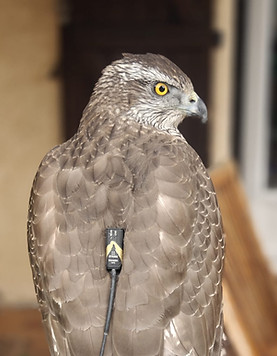
3.8 million birds per year, and falconers and conservationists attach radio-telemetry to birds since decades.
Equipping a specimen with bAWARE is like vaccinating it against several deadly dangers. The device knows or senses where the danger is, and possesses actuators capable of altering the animal's behavior.